The method of treatment of drinking water has been studied and applied for centuries aimed at protecting public health from pathogenic bacteria as well as harmful chemicals may be in the water source. Depending on the quality of the source water, suitable treatment techniques will be selected to use. Below, Scimitar Vietnam lists some of the main water treatment methods used to treat drinking water.
The role of water treatment
In the face of the current situation of surface water and groundwater pollution, the study of water treatment methods is indispensable in protecting the health of the community from pathogenic bacteria as well as harmful chemicals that may have harmful effects on the environment. in the water source.
In rivers, lakes, boreholes and water bodies, there are often many suspended substances, some dissolved minerals, odors and microorganisms that cause human diseases such as:
Suspended solids in water such as copper sulphate acid, copper oxygen, toxic substances belonging to organochlorine substances, organophosphates, aluminum oxides, iron oxides… cause damage to parts of the body…
The smell in water is caused by bacteria as well as decomposed organic impurities. These impurities in water will cause discomfort to the body when used, affecting the respiratory system, digestive system …
Heavy metals in water such as mercury, lead… accumulate in the body for a long time and can cause death.
In water there are always bacteria and viruses, which are infectious agents of dangerous diseases.
Therefore, before being used for domestic purposes, these types of water need to be treated to remove suspended matter and iron. Usually in the countryside, water taken from rivers and lakes must be beaten with alum, settled or filtered through a thick layer of gravel and sand before being used. In urban areas, when possible, people disinfect to kill disease-causing germs in the water and supply that water to users through a closed pipeline system.
Depending on the method of treatment and disinfection, the water can be clean enough to drink. However, the higher the level of sterilization, the higher the production cost, which increases the cost of water. Therefore, not everywhere people disinfect tap water to the point where it can be drunk immediately.
People have made special filters, which only let water pass and retain all pathogenic microorganisms as well as water-soluble substances. The filtered water will be as pure and clear as distilled water.
However, this water, like distilled water, is not completely beneficial to human health, although they do not contain disease-causing germs, they may not have enough dissolved mineral salts needed by the human body. people.
Boiling is the simplest and most effective way to kill pathogenic microorganisms. However, while boiling, it is necessary to let the water boil for a while, especially when boiling water in the domestic water purifier machine price in bd high mountains. Bottles of boiled water to cool, bottles of half-drink soft drinks must be tightly closed to avoid insects.
Methods of treating drinking water
Clean drinking water is very important to public health. However, at present, drinking water is strongly polluted, which greatly affects human health.
Because Chlorine (a chemical used for sterilization) has been shown to be a derivative of some cancers, such as Chloroform (a type of Trihalomethane) and the smell of Chlorine is not only difficult to drink but also makes the skin dry and itchy. …
Because chemicals from pesticides, herbicides, and fertilizers do not dissolve in water
Due to heavy metals.
Due to the contamination of microorganisms, bacteria and viruses, it gradually becomes a source of environmental pollution that endangers human life.
Current drinking water treatment methods focus on three main processes, coarse filtration, disinfection and fine filtration. Depending on the conditions of the inlet water source and the quality requirements of the outlet water, the system is selected and designed reasonably. The following is an introduction to some drinking water treatment methods that are being applied in life.
- Coarse filter method
Pre-filtration method is used to remove organic impurities, dirt and microorganisms in water
1.1. Physical filter
a. Create sediment very slowly
Using coal, sand and gravel in a sedimentation tank or continuous filtration tanks, sometimes even using a blower or artificial rain screen to bring in O2 to settle alum, deodorize and gradually remove impurities suspended in the air. country.
Inexpensive equipment effectively reduces TOD by over 90%, bacteria to 95-98%, but takes a long time from 21~45 days (now this technique has been improved to make biofilm time natural 5-7 days left) and bulky. Application for the input water area with high content of alum, organic impurities in the water.
b. Membrane, filter element
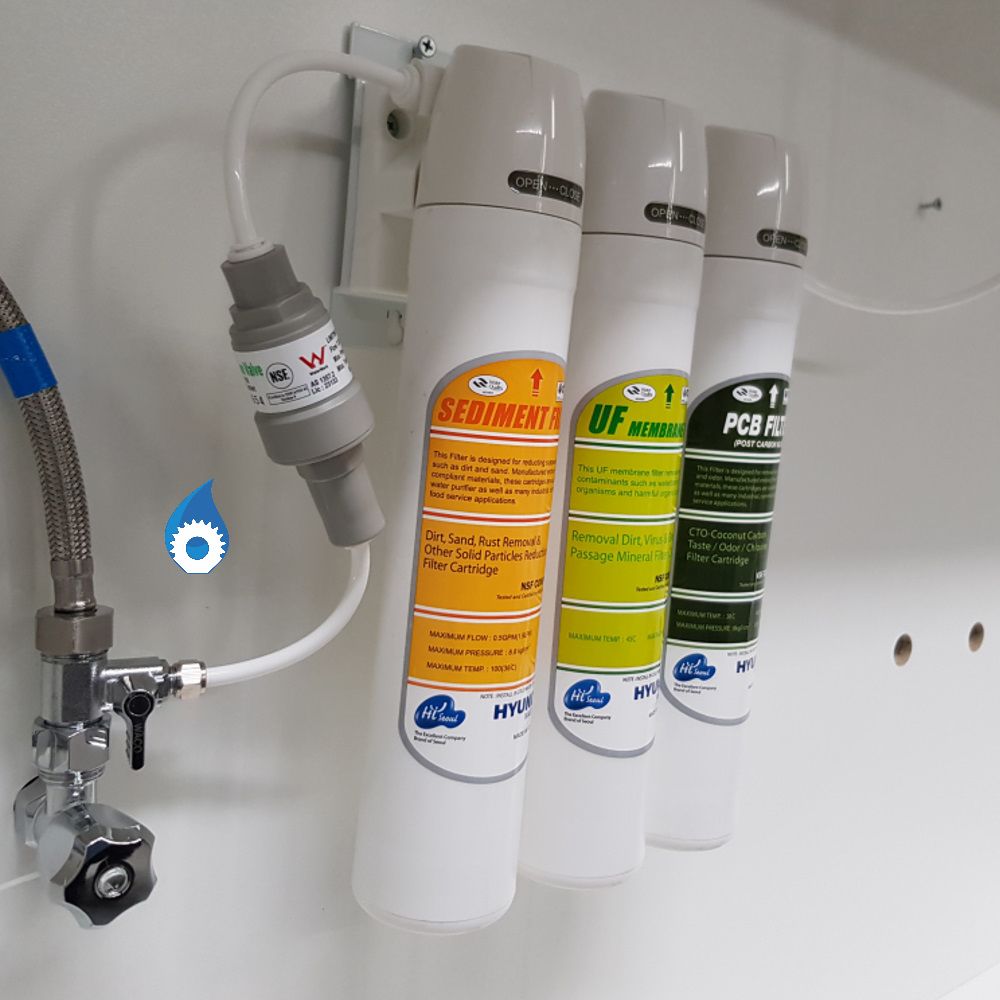
These types of membranes (filter cores) are divided into many layers or layers, including a layer (or layer) of activated carbon to deodorize or add a layer of bactericide. This type of filter element is very convenient to use and replace, compact and does not take up space compared to classical methods. However, the pre-filter does not completely handle harmful chemicals arising from water sources or pathogenic bacteria.
1.2. Chemical filtration
a. Sedimentation/flocculation method
The principle of the settling method is to use gravity to remove the solid particles present in the water. In drinking water treatment, to increase the efficiency of the settling method, people combine the settling method with the coagulation method.
Coagulation method in water treatment process is known as the process of binding or flocculating solid particles suspended in water into larger sized particles and capable of settling to the bottom of the settling tank. Flocculants commonly used in drinking water treatment include aluminum and iron salts or artificial polymer granules.
After the flocculation process, large enough flocs are formed, and natural settling will take place.
b. Ion exchange method
The ion exchange method is based on the principle of absorbing opposite ions of charge carriers. Water usually contains charged ions (-) called anions and charged particles (+) called cations. When conditions are favorable, ions with opposite charges combine to form larger particles and settle to the bottom.
Materials used in ion exchange tanks are usually artificially charged plastic particles. The charged plastic particles are responsible for attracting oppositely charged particles in the water and forming flocs.
The ion exchange process is used to remove inorganic impurities left behind after settling and filtration. Ion exchange methods can be used to soften water, removing calcium and magnesium ions. In addition, this method is also used to remove heavy metal ions from water such as arsenic, chromium, and non-metal ions such as fluoride, nitrate, radium and uranium.
c. Adsorption method
It is a method that uses substances with high surface activity such as activated carbon to adsorb organic impurities in water. This is also the method used to use organic contaminants that cannot be removed during settling and filtration. Besides removing organic contaminants, adsorption is used to remove color, odor and taste present in water.
d. Iron reduction method
Iron in groundwater exists in the form of valence iron II (Fe(II)). Fe(II) when exposed to oxygen will be reduced to Fe(III) which precipitates and settles to the bottom. Therefore, to reduce iron, people often use the simplest method, which is rain. Water is sprayed on the rain rig into small drops, in the process of falling in contact with oxygen in the air to precipitate Fe(OH)3.
- Fine filtration method
The fine filtration method removes organic impurities, dirt and microorganisms in water less than 1 micrometer.
2.1. Ultrafiltration membrane (micro filter)
The fiber ultrafiltration membrane with a matrix structure with 0.2~0.4 mm filter holes has the ability to prevent germs and bacteria quite well and applies the principle of reverse osmosis. The reverse osmosis (RO) membrane method is one of the most commonly used membrane filtration methods.
The RO method is a pressurized system, so it is usually more energy-intensive than any membrane method because it uses electrical and mechanical energy to maintain the required pressure in the system.
Due to the pressure in the system, the pores on the membrane filter can be smaller in size than other types of membranes, allowing the majority of impurities to be removed and the dissolved salts present in the water retained. Reverse osmosis membranes (RO membranes) are made of Cellulose acetate, polyamide or TFC membranes with microscopic pores (≤ 0.001µm).
Other membrane filtration methods include nanofiltration (NF), ultrafiltration (UF), microfiltration (MF), and electrodialysis (ED).
2.2. Silver Nitrate Coated Porcelain Filter Tube
This technique was invented in 1947 when the technique of forming ceramic filter tubes with pore size 0.2-0.4 micron was established. As we all know, germs or bacteria have an average size of 0.5-0.6 microns, so this filter can stop them and to be more secure, prevent bacteria from growing. core to the inside of the filter tube, they mixed
Silver nitrate into the porcelain solution (before firing) does not allow the silver to fall off when the water passes through, and at the same time promotes the effectiveness of direct disinfection in water instead of using fluorine, iodine or chlorine chemicals that can cause long-term harm when concentrations are not strictly controlled.
In addition, the intestine of the tube is a layer of quartz impregnated with silver nitrate to prevent bacteria from mixing from the drinking faucet (output) back to the filter tube (re-infection), ensuring that the treated water source is not contaminated. re-infection.
With the silver nitrate ceramic filter tube, people can feel more secure and quite handy because it is possible to clean the filter tube every time it is clogged (due to bacteria or dirt accumulation) instead of having to discard or replace the tube. new filter such as Cartridge made of man-made fibers. According to the research results of the manufacturers (Katadyn Switzerland and Roki Japan), the ceramic filter tube will lose its effect when the outer porcelain part is worn out after 3-5 years of use.
In practical terms, it is difficult to apply this filter tube to large-scale water treatment systems because the cleaning of the pipe cannot be done easily, and the cost is quite expensive compared to other solutions but with this type of filter. For families, this type of filter is quite ideal and has been provided by the World Health Organization (WHO) to hospitals and clinics in some countries in the public health program.
- Sterilization
Water should be disinfected before use or before being distributed to households to ensure that harmful bacteria are killed. Water can be disinfected by physical or chemical methods
3.1. Physical method
a. Ultraviolet (UV) light sterilization
UV rays (with wave length 254nm) have very good germicidal ability and are quite cheap, but using ultraviolet lamps has certain difficulties such as: The stability of the current used (not fluctuating ± 5%) ); Must be used continuously or it will be contaminated again (because the water continues to flow).
Ultraviolet rays only have a sterilizing effect, without the function of water filtration (physico-chemical), so it is often used in laboratories with small flow or in large systems that are capable of testing. monitoring and absolute power stability.
UV water treatment systems are often combined with other components (pre-filtration and purification) to be effective. UV sterilization under adequate conditions is an ideal method and is not as harmful as is the case with chemicals.
b. Heat sterilization
It is a common, easy to implement and effective method to kill pathogenic bacteria. This method is often used on a household scale. To ensure sterilization, water should be boiled to 1000°C for 15 minutes.
c. Disinfect with ultraviolet rays
Ultraviolet rays are electromagnetic radiation with wavelengths from 4 to 400 nm, which have the effect of changing the DNA of bacterial cells. Ultraviolet light of 254nm wavelength has high sterilization effect. To ensure good sterilization, the water must be clear and have sufficient contact time.
One way to take advantage of natural ultraviolet rays is the sun’s rays. In hot areas, water can be stored in clear, colorless plastic/glass bottles and left in the sun for at least 30 minutes. This simple method can kill bacteria that may be present in the water under the effect of ultraviolet rays from the sun.
d. Ultrasonic sterilization
The ultrasonic current with an intensity of ≥ 2W/cm2, within a contact time of 5 minutes, is capable of destroying all microorganisms present in the water.
3.2. Chemical method
Chemicals used to disinfect water include silver, iodine, ozone, chlorine, and chlorine-containing disinfectant compounds (such as chloramine or chlorine dioxide – ClO2). In most water plants in Vietnam, people disinfect with chlorine or chlorine compounds due to the high efficiency of killing pathogenic bacteria.
The above disinfectant chemicals are applied at water plants to disinfect water before distribution to households, or can also be used by households to disinfect at home.
a. Chlo
One of the most common chemicals used in water treatment since the turn of the century is chlorine because it kills all bacteria in water, although other chemicals present in water such as phenol react Reacting with Chlorine can produce an unpleasant taste and odor in drinking water. With only an amount of Chlorine 0.16 mg/l (at pH=7) or 0.45 mg/l (pH=9), people feel the water has an unpleasant odor.
In addition, the Ammonia substances in the water will react with Chlorine to produce Chloramines (Mono, Di and Trichlororamine) or Phenol which also makes the water smelly. However, in industrial water treatment plants, people still use Chlorine and adjust its concentration according to the content of bacteria and other (chemical) impurities in the water because of this method of water treatment. The cost of tap water is still the cheapest.
In the early 70s, people discovered many chlorine derivatives in water and a series of toxins derived from chlorine such as Trihalomethane (THM). Trihalomethane is an organic carbon compound with the formula CHX3 where X is a halogen molecule (such as Bromine, Fluorine or Iodine).
There are four main types of THM in drinking water: Chloroform (CHCl3), Bromo dichloromethane (CHBrCl2), Dibromochloro methane (CHBr2Cl) and Bromoform (CHBr3). THM compounds or chlorine derivatives can only be found in drinking water when the water is disinfected with chlorine. Depending on the chlorine concentration, water temperature and pH, THM will generate more or less due to organic impurities reacting with Chlorine when the Chlorine content is overdosed.
In addition to the chlorine concentration factor, THM increases with the temperature and pH of the water, generating many other toxins (if the water source has been contaminated with chemicals or pesticides…). The most worrying is Chloroform because with only 44g of Chloroform can kill a person weighing 70kg and because the amount of Chloroform in water will cause cancer if this drinking water is used for a long time. According to WHO, if the water contains Chloroform, then cancer complications (bladder, intestinal and rectal) will occur.
b. Flo, Iod
When these chemicals are used, strict concentration control and precautions are required. According to popular standards, fluorine content is only allowed 0.6mg/l – 1mg/l, but if used for a long time, it will damage the enamel on the teeth.
Currently, there are still objections to the use of fluorine for children for reasons such as: extremely toxic inorganic chemicals, difficult to test the fluorine content in water if used on a regular basis, difficult Monitoring and checking how much the body has absorbed, fluorine is also capable of destroying bacteria necessary for the digestive system.
Theoretically, fluorine, iodine, and chlorine are very effective disinfectants, but in practice, it is very rare to see water purifiers that use iodine for home use in many countries around the world (France, USA, Japan, Switzerland) Si).
Cobalt60, Iodine131 are b-radiation substances with a significant health risk. WHO limits the concentration of b to be used only 1.0 Bq/liter (1 pci is equivalent to 3.7 x 10¹⁰ Bq) and this monitoring is extremely complicated, requiring specialized equipment to measure radiation concentrations. administered by the atomic force agency.
The standards for radioactivity a and b of the Ministry of Health of Vietnam are similar to those mentioned above by WHO, while the Vietnamese standard of the General Department of Standards, Metrology and Quality is 3 pci/liter. WHO says using Iodine is a temporary sterilization method for a very short time, should not be used in the treatment of drinking water regularly.
c. Ozone
Ozone (O3) is also an effective disinfectant due to its strong oxidizing properties. Ozone destroys all types of bacteria in water (it only takes 1ppm (1 part per million) in 10 minutes to disinfect), but Ozone causes a very pungent odor, difficult to drink, so it is often used with a filter. Activated carbon to reduce this odor in modern water purification equipment, but the concentration control is relatively complicated and quite expensive.
Currently, the ozone sterilization method is applied at central water treatment stations in rich countries, where there are automatic control and control conditions such as Japan and Switzerland. This is a quite economical and convenient method in industrial water treatment technology, especially effective for factories using water as raw materials such as in the field of medicine and pharmaceuticals, drinking water mixed with vitamins and minerals. cosmetic field.
d. Silver ions
With the silver ion sterilization method, silver ions are added to the water at a rate of 0.005-0.1 mg/l. Silver ions are bactericidal (olidodynamic). However, specific bactericidal efficacy is unknown, and long-term protection against bacteria cannot be guaranteed. Processing takes several hours. Currently, this process is mainly used in the disinfection of drinking water on ships or for the supply of water to disaster areas.



 greendotbd.finance.blog